THE COLOSSAL FAILED OPEN BOOK EXAM
THE FAITHFUL — THE STORY OF SARAH

A special edition from Ink & Utterance — in honor of Holy Week and the Resurrection.
⚠️ NOTE: This post contains details about the movie The Faithful: Women of the Bible. If you have not watched it and do not want spoilers, please scroll past
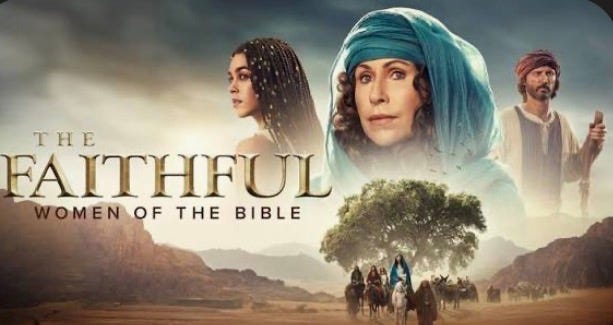
I was so looking forward to watching The Faithful: Women of the Bible — the story of the four matriarchs of the Bible. I should have known that Hollywood would find a way to put a stain on what God has so beautifully painted for us in His Word.
I came expecting caviar. Hollywood served fish paste in a crystal dish.
It is like the lie the serpent told the woman in the garden. It contains some truth. Some emotional resonance. Some genuine performances. Some moments that actually moved me. But it misses the mark just enough, in precisely the right places, to lead to spiritual death.
I want to be transparent — Genesis happens to be one of my favorite parts of the Bible. So this was particularly painful to watch.
I also want to be clear — I was not sitting down with a notepad intentionally looking for errors. I was simply watching. Casually. Without paying particularly close attention. And within the first 15 minutes I had already found three distortions so glaring I could not ignore them. So I started documenting. And the list just kept going. Theology mutilating does not begin to cover it.
The Serpent’s Method
The enemy did not deny God’s words in the garden. He wove in enough truth to feel plausible. He named the right characters. He acknowledged the actual command. And then he shifted the emphasis just enough — “You will not surely die” — to redirect the entire story away from God’s sovereign word and toward human agency, human desire, and human wisdom. The result contained truth. But it missed the mark. And that miss led to death.
This series operates the same way. It names the right characters. It hits some plot beats. It shows genuine human longing and faith struggles. Abraham and Sarah are recognizable. Some moments land with real emotional weight.
But the omissions, reversals, and reframings do not merely fill in blanks. They redirect the entire story’s gravity, away from God’s sovereign initiative, covenant election, and gospel typology, straight into modern emotional drama and subtle role inversion.
And that kind of miss, on the bedrock narratives of redemptive history, carries real spiritual weight.
Not the death of bodies. But the slow erosion of seeing God as He has revealed Himself.
That is why this matters. That is why I am writing this.
A word about creative license:
I understand that any film adaptation of Scripture will require creative license. Filling in emotional texture, elaborating on human dynamics that the text leaves silent, giving voice to characters whose inner lives Scripture does not fully narrate. These are legitimate and sometimes even beautiful tools of storytelling. I am not opposed to that. I am not expecting a word-for-word screen reading of Genesis.
For example — the film depicts Sarah as resentful when Hagar conceived and complaining to Abraham that he could have protested more. These elaborations, while not verbatim Scripture, have roots in Genesis 16:5 where Sarah says to Abraham: “The wrong done me is your fault!” That human texture is fair game.
What I cannot live with, and what I am documenting here, are errors that are outright, blatant, and fundamental. The ones that do not merely fill in silence but actively contradict, reverse, replace, and distort what Scripture plainly says. The ones that change the meaning of the text. The ones that advance a theological agenda that is incompatible with the God this story is actually about.
Because this story is not simply a collection of interesting women’s narratives. This story is the bedrock of Christianity. God is the God of Abraham, Isaac, and Jacob. Yes, the women were important. Yes, God featured them prominently and honored them in ways that were radical for their time. But we cannot cast them in a feminist light rather than in the light that God Himself depicted them. The moment we do that we end up making God smaller in the process of trying to make the women larger. And the women of Genesis — as God wrote them — are already extraordinary. They do not need Hollywood’s help.
A note on Sarah’s concern for Isaac:
Before I list the errors I want to address something important — because it bears directly on how the film misrepresents Sarah’s motivations.
Scripture is clear that Sarah’s concern for Isaac was real, maternal, covenantally grounded, and divinely validated. Genesis 21:10 records her explicit reason for the expulsion: “the son of this slave woman shall not share in the inheritance with my son Isaac.” This was not paranoia or wickedness. Under ancient Near Eastern law Ishmael as firstborn had a legitimate inheritance claim. Sarah was protecting what God had already promised to Isaac.
Furthermore the Jewish historian Josephus records that Sarah feared a repeat of the Cain and Abel situation — that Ishmael being 14 years older than Isaac could become a physical threat to him. While this is not verbatim Scripture it is a historically respected interpretation of Sarah’s motivations rooted in what Genesis 21:9 describes as Ishmael mocking Isaac.
And most profoundly — the midrashic tradition and Rashi both connect Sarah’s death directly to her hearing about the near sacrifice of Isaac on Mount Moriah. She died from the shock and grief of learning how close she came to losing her son. That is the deepest expression of maternal love for Isaac in the entire Sarah narrative.
Sarah’s concern for her son was not the behavior of a villain. It was the behavior of a mother who understood — perhaps better than anyone — what Isaac represented. Not just her son. The promise. The covenant. The future of everything God had spoken.
Hollywood depicted her concern as wickedness. Scripture depicts it as faithfulness.
René Echevarria:
I want to be fair. I commend René Echevarria — the producer and showrunner — for trying. He is a sincere Catholic who prayed over this project — “God, use me. If it pleases you, use me to tell your story” — and consulted scholars with the aim of not contradicting Scripture outright. He clearly cared about the women of Genesis in a way that most productions have not. Centering Sarah, Rebekah, Leah, and Rachel and giving each matriarch two full hours of screen time shows a seriousness of intent that deserves acknowledgment.
But sincerity is not the same as accuracy. And aiming to “not contradict outright” is precisely the serpent’s method. Not total denial. Just enough shift to make the story about human agency, relatable women, and sympathetic victims. Not the God who sovereignly calls, elects, validates, and foreshadows the Lamb on Moriah.
That shift, however sincere, has consequences. Because millions of people will watch six hours of Genesis during Holy Week and come away with a story that feels biblical enough to draw them in — yet points them to a smaller God and a different gospel.
Good intentions do not sanctify bad theology. And this was a colossal failed open book exam.
What post-premiere reviews and the producer himself confirm:
Since the episodes aired March 22–23, independent reviewers have openly confirmed many of the distortions documented below.
Collider called the sister lie reversal a reworking that makes the adaptation feel “unrecognizable” — a fundamental misunderstanding of the text. They also noted directly that the production “seems to bypass the most important and certainly most thought-provoking chapter in the Abraham saga: the sacrifice of Isaac.” RogerEbert.com confirmed Abraham as “a side character” in his own story while Sarah is framed as the dominant force. Watching the episode myself, his faith reads as little more than a hobby Sarah tolerates. Forward confirmed that Hagar narrates Sarah’s story, that their deep friendship and sisterhood is heavily emphasized throughout, and that Hagar delivers the closing verdict over Sarah’s life — calling her “the first of the great matriarchs” who “came to symbolize motherhood.” Forward also described the production as skipping the binding of Isaac entirely — calling it “Tanakh by way of Nicholas Sparks.” Plugged In acknowledged “a lot of guesswork,” “plot points altered for dramatic impact,” and material “left out entirely to keep the story moving.” Slate confirmed the Akedah is skipped entirely in Sarah’s episodes.
Most significantly, René Echevarria himself confirmed in post-premiere interviews that the Akedah was deliberately cut from Sarah’s episodes and relocated to Rebekah’s story to preserve viewers’ sensibilities. That is not an oversight. That is a documented creative choice. Made by a sincere man who nonetheless moved the single passage that ties Genesis to Calvary out of the episodes covering Abraham and repositioned it as someone else’s emotional arc because he was concerned about how audiences would receive it.
If you are going to tell the story, tell it the way it is.
Even the outlets that liked the series confirmed the pattern. It is not accidental. It is consistent.
What they got right:
In the spirit of fairness I want to acknowledge two things the film depicted correctly.
The first — Abraham’s deep and tender love for Sarah was portrayed with genuine warmth and authenticity.
The second — Abraham’s love for Ishmael was also depicted honestly — showing a father genuinely torn and grieving, which Scripture supports in Genesis 21:11.
These moments worked because they honored what the text actually says. Would that the rest of the production had done the same.
The Story They Could Have Told
This is the real tragedy of this production. They did not just get things wrong. They walked past gold.
Sarah is already one of the most compelling figures in all of ancient literature — without a single invention. A 90-year-old woman conceiving a child. A woman who laughed secretly at the impossible and was exposed by divine omniscience. A woman who left everything she knew — country, family, social standing — on the word of a God she did not yet fully know, simply because her husband heard His voice. A woman whose beauty made her a target for the most powerful men in the ancient world — and who learned that God was a more reliable shield than any palace wall. A woman who made a desperate human decision to help God’s promise along — gave her own servant to her husband — and bore the full painful weight of that choice without flinching from it. A woman who stood by her clan above her own feelings. A woman who owned her mistakes. A woman who came — slowly, painfully, miraculously — to trust a God who specializes in the impossible.
That is the story. It did not need enhancement. It did not need a feminist reframe. It did not need Hagar’s eulogy or a secret document or a romantic rival at the opening.
It needed someone willing to trust that a 90-year-old woman having a baby — against every physical, psychological, emotional, and social barrier known to human experience — is already the most compelling story in the room.
They had that story in their hands. And they traded it for a soap opera.
Now I find myself deeply concerned about what they are going to do with the remaining matriarchs — Rebekah on March 29 and Leah and Rachel on Easter Sunday April 5. If the same interpretive lens is applied — and the Akedah has already been confirmed as repositioned to Rebekah’s episode — the pattern will only deepen. The same theological trade will be made. Human drama for divine sovereignty. Emotional texture for typological truth.
This is Easter season. Next week is Holy Week. The series airs its finale on Easter Sunday itself. And the very passage that explains what Easter means has been deliberately moved to someone else’s emotional arc.
That is not a scheduling coincidence. That is a theological statement.
I pray that Christians will rise up, open their Bibles, and refuse to let Hollywood rewrite what God has so carefully and beautifully written. The Word of God does not need Hollywood’s polish. And it certainly does not need Hollywood’s edits.
THE FUNDAMENTAL ERRORS
I documented at least 23 errors. What follows are all of them — some given full treatment because of their theological weight, others documented briefly because the pattern they reveal matters even when the individual error is less consequential.
If time is short, I encourage you to read at minimum: Error 3 (Abraham depicted as weak and without agency), Error 4 (the sister lie reversed), Error 8 (the invented contract document and Ishmael’s fabricated identity crisis), Error 13 (the expulsion of Hagar and Ishmael completely rewritten), Error 14 (Sarah cast as a subtle villain), Error 17 (Hagar inverted into the moral center of the narrative), and Error 23 (the Akedah deliberately repositioned). Those seven carry the full theological weight of what this production chose to do. The remaining sixteen confirm the pattern.
ERROR 1 — Sarah chooses Abraham over a wealthy suitor
The film opens with a young Sarah refusing a wealthy suitor and choosing the poorer Abraham instead — establishing her superior judgment from the first frame and introducing Abraham’s poverty as a known, accepted condition before the story even begins. Scripture records no such courtship and no rival suitor. Genesis 11:29 states simply: “The name of Abram’s wife was Sarai.” Their union is a covenant origin story, not a romantic choice between suitors. This invention reduces the covenant origin of the Abraham-Sarah marriage to a love story about a girl who picked the underdog — and makes Abraham’s later covenant abundance impossible to receive as the blessing Scripture presents it as.
ERROR 2 — Abraham depicted as poor
Abraham is portrayed as a wandering pauper throughout the entire film including at the end of his life. Scripture records the opposite — he was very rich in livestock, silver, and gold (Genesis 13:2), commanded 318 trained fighting men (Genesis 14:14), paid 400 shekels of silver without flinching for Sarah’s burial ground, and died “in a good old age, an old man and full of years” (Genesis 25:8). His wealth was not incidental — it was the visible testimony of God’s faithfulness to His covenant promises, and depicting him as poor throughout removes that testimony entirely.
ERROR 3 — Abraham depicted as weak and without agency
Film: Abraham is portrayed as fragile, uncertain, passive, and dominated throughout. The episode is titled “The Woman Who Bowed to No One” — and it delivers on that framing by making Abraham the one who bows instead. At the end of Sarah’s life he is still shown as a weak, spineless figure standing outside his own wife’s tomb. Independent critics confirmed this — RogerEbert.com noting Abraham as “a side character” in his own story while Sarah is the force to be reckoned with.
Scripture: Abraham was a decisive military commander who defeated four kings (Genesis 14), a bold intercessor who pressed God six times (Genesis 18), a man of immediate obedience who rose early and acted without hesitation, and a man whom the Hittites called “a mighty prince among us” (Genesis 23:6). Scripture never once depicts Sarah as stronger than Abraham. He is the covenant recipient, the friend of God, the commander of armies, and the man kings sought treaties with.
Why it matters: A weak Abraham cannot carry the theological weight of what his life represents. The father of faith was not a passive, dominated man. He was a man who moved mountains at God’s word.
ERROR 4 — The sister lie reversed
Film: Sarah originates and drives the lie about being Abraham’s sister. Collider confirmed this directly — calling it a fundamental misunderstanding that makes the adaptation feel unrecognizable.
Scripture: Abraham initiated and orchestrated the deception both times — “Abraham said of Sarah his wife, she is my sister” (Genesis 12:13, Genesis 20:2). It was his moral failure, not hers.
Why it matters: Reversing this transfers Abraham’s documented moral failure onto Sarah, exonerates a patriarch whose flaws Scripture records honestly, and continues the pattern of making Sarah the agent of every difficult decision in the narrative. The Bible does not whitewash its heroes — and neither should we.
ERROR 5 — Abraham depicted as attracted to Hagar
Abraham is shown as romantically attracted to Hagar, casting a shadow of divided loyalty over his marriage. Scripture records the arrangement with clinical brevity — Sarah gave Hagar to Abraham, he slept with her, she conceived — with no language of attraction or desire anywhere in the text. The only emotion Abraham expresses toward Hagar is indifference: “Your maid is in your hands, do with her whatever you think right” (Genesis 16:6). Inventing romantic attraction replaces divine providence with personal drama and diminishes the covenant fidelity Scripture assigns to Abraham.
ERROR 6 — God’s sovereign judgment on Pharaoh’s household replaced with witchcraft accusations
Film: God does not send plagues on Pharaoh’s household. Sarah is accused of being a witch with supernatural powers.
Scripture: God directly struck Pharaoh and his household with great plagues specifically to defend Sarah’s honor (Genesis 12:17). No explanation was given. No negotiation occurred. God simply acted sovereignly on behalf of Sarah.
Why it matters: Replacing God’s direct sovereign judgment with witchcraft accusations removes God from His own story entirely and turns His protective action into Sarah’s personal supernatural power.
ERROR 7 — The plague on Pharaoh’s household reduced to one man bleeding
The judgment is depicted as blood coming from Pharaoh’s eyes, ears, and nose — a cinematic horror effect on one man’s body. Scripture records a corporate and sweeping divine act: “The LORD afflicted Pharaoh and his house with great plagues because of Sarai, Abram’s wife” (Genesis 12:17). Reducing a sovereign judgment on an entire royal household to a personalized physical affliction strips the passage of its corporate theological scope entirely.
ERROR 8 — The invented contract document and Ishmael’s fabricated identity crisis
Film: A secret written contract agreement between Sarah and Hagar is invented and hidden in Abraham’s tent. Ishmael discovers this document as a grown man and through it discovers he is not Sarah’s son — triggering an identity crisis that drives the rest of the narrative. Post-premiere reviewers confirmed this invented document as the primary emotional engine of the production — turning what Scripture presents as divine election into manufactured human trauma.
Scripture: No such document exists anywhere in Scripture or in ancient Near Eastern custom. The surrogacy arrangement was a publicly understood cultural practice openly conducted before the entire household (Genesis 16:3). Ishmael was raised knowing exactly who he was. Abraham named him, raised him openly, and circumcised him personally at thirteen as a covenant act (Genesis 17:23). His identity was never hidden, never a secret, and never a source of crisis.
Why it matters: This single invention drives multiple subsequent distortions. It manufactures a wound that Scripture never gives Ishmael, explains his conflict with Isaac through personal trauma rather than divine election, and turns a story about God’s sovereign purposes into a soap opera of hidden documents and family betrayal. It is the serpent’s method applied to narrative structure — enough truth to feel plausible, enough shift to redirect everything.
ERROR 9 — The announcement of Isaac’s birth and the complete omission of Sarah’s laughter
Film: Hagar overhears the three visitors speaking and brings the news to Sarah inside the tent secondhand. Sarah’s laughter is not depicted at all.
Scripture: Sarah herself was stationed at the tent door behind Abraham listening directly (Genesis 18:10). She heard the promise with her own ears. She then laughed secretly and inwardly, to herself, silently, in her own heart. No one saw it. No one heard it. And God exposed it supernaturally — “Why did Sarah laugh?” She denied it out of fear and God replied: “No, but you did laugh” (Genesis 18:12–15).
Why it matters: Making Hagar the intermediary eliminates Sarah’s direct encounter with the divine promise. And omitting the laughter entirely destroys one of the most powerful moments of divine omniscience in all of Scripture — God exposing the secret movement of a human heart that no one else could see or hear.
ERROR 10 — Abraham’s intercession for Sodom omitted
The intercession is cut entirely — removing one of the most extraordinary dialogues in all of Scripture, Abraham standing before God and pressing Him six times, from fifty righteous down to ten, declaring “Shall not the Judge of all the earth do right?” (Genesis 18:16–33). This passage establishes God as the righteous Judge of all nations and Abraham as a bold, persistent intercessor. Its omission leaves Sodom’s destruction without theological context and removes one of the greatest portraits of intercessory prayer in the entire Bible.
ERROR 11 — Number of men going to Sodom misrepresented
The film misrepresents the number of men involved in the Sodom narrative. Scripture is precise: three men came to Abraham at his tent (Genesis 18:2), two turned toward Sodom (Genesis 18:22), and THE LORD remained behind specifically to have the intercession conversation with Abraham. The group split because of the intercession the film omitted — and misrepresenting the number obscures that reason entirely.
ERROR 12 — Sarah and Abimelech given a prior romantic relationship
The film gives Sarah and Abimelech a prior romantic history and portrays Abraham as a violent aggressor against the king. Scripture records no prior relationship — Abraham lied again saying Sarah was his sister (Genesis 20:2), God appeared to Abimelech directly in a dream, and God explicitly acknowledged the king’s innocence: “I know that you have done this in the integrity of your heart” (Genesis 20:6). This invention eliminates one of the most theologically significant details in the passage — that God held a pagan king to a standard of sexual integrity and explicitly vindicated him.
ERROR 13 — The expulsion of Hagar and Ishmael completely rewritten
Film: The expulsion is triggered by Ishmael finding the contract document, discovering he is not Sarah’s son, Hagar defending him, and Sarah ordering them to leave because she fears Isaac will not be safe now that Ishmael knows he was supposed to inherit instead of Isaac.
Scripture: The expulsion was triggered by Sarah seeing Ishmael mocking Isaac at the weaning feast (Genesis 21:9). God explicitly validated Sarah’s judgment — telling Abraham “listen to whatever Sarah tells you” (Genesis 21:12). The separation was not about Isaac’s physical safety from a discovered secret. It was God’s sovereign distinction between two covenant lines. Paul interprets this in Galatians 4:29 as the one born of the flesh persecuting the one born of the Spirit — a typological statement about law versus grace.
Why it matters: This rewrite destroys the entire typology Paul builds in Galatians 4. It turns a divinely ordered covenant distinction into a fearful mother’s security decision and makes Sarah reactive and calculating rather than prophetically discerning.
ERROR 14 — Sarah cast as a subtle villain even though the story is about her
Film: Sarah is portrayed throughout as imperfect in a way that edges toward villainy — unreasonable, calculating, and the primary cause of the family’s suffering — even though she is the central character of this installment. Post-premiere reviewers confirmed this framing — noting Sarah’s jealousy and secrecy as primary character traits while Abraham is simultaneously sidelined.
Scripture: God explicitly validated Sarah’s judgment — “listen to whatever Sarah tells you” (Genesis 21:12). Peter holds Sarah up as a model of holy womanhood (1 Peter 3:6). Hebrews honors her faith (Hebrews 11:11). Paul uses her as the very type of grace and freedom (Galatians 4). God Himself in Isaiah 51:2 says: “Look to Abraham your father and to Sarah who bore you.” Her concern for Isaac was not wickedness — it was covenantal faithfulness.
Why it matters: Villainizing the central character of your own story while honoring the supporting character reveals the theological agenda of the entire production. Every major New Testament writer who references Sarah honors her. Hollywood condemned the woman God commended.
ERROR 15 — Sarah confesses to planting the document deliberately
Sarah confesses that she deliberately planted the invented contract document where Ishmael would find it, saying she gave him someone to hate — herself — so he would leave. No such document existed and no such confession exists anywhere in Scripture. God directed the expulsion (Genesis 21:12), Sarah requested it based on what she witnessed, and God validated it. This invented confession makes Sarah the deliberate architect of Ishmael’s pain — stealing that role from God’s sovereign election and turning a theological reality into a human conspiracy.
ERROR 16 — Sarah redefines the expulsion as protecting Ishmael from Isaac’s shadow
Sarah says she arranged Ishmael’s departure so he would not grow up in Isaac’s shadow. The expulsion had nothing to do with sibling rivalry or shadow dynamics — it was God’s sovereign distinction between two covenant lines established before either boy was born (Romans 9:11). Reducing divine election to a mother’s management of sibling dynamics psychologizes one of the most theologically significant acts of divine sovereignty in the entire Old Testament.
ERROR 17 — Hagar inverted into a martyr figure, narrator, and moral center of the narrative
Film: Hagar is transformed into a pure sympathetic victim, the narrator of Sarah’s own story, and the moral center of the entire narrative. Forward confirmed that Hagar and Sarah’s deep friendship and sisterhood is heavily emphasized throughout, with Hagar elevated as the emotional and moral anchor of the production.
Scripture: Paul in Galatians 4 is explicit — Hagar represents the covenant of law, bondage, and Sinai. Sarah represents the covenant of grace, freedom, and the heavenly Jerusalem. Inverting their moral positions inverts the typology of grace itself.
Why it matters: This is not a personal judgment on Hagar as a woman. God loved her, heard her, and blessed her son. But her typological role in Scripture is specific and cannot be reversed without dismantling the theological architecture Paul builds in Galatians 4.
ERROR 18 — Hagar delivers the closing eulogy over Sarah’s life
Film: Hagar delivers the final spoken verdict over Sarah’s legacy. Forward confirmed her exact words from the production — calling Sarah “the first of the great matriarchs” who “came to symbolize motherhood,” calling her “my friend,” and saying “there won’t soon be another like you.”
Scripture: Sarah’s legacy is spoken over her by God, by Paul, by Peter, and by the writer of Hebrews — not by Hagar. God Himself declares in Isaiah 51:2: “Look to Abraham your father and to Sarah who bore you.” Scripture never once describes Sarah and Hagar as friends.
Why it matters: Giving Hagar the closing eulogy over Sarah’s life makes Hagar the moral authority of the entire story — the one who bestows Sarah’s legacy, pronounces her benediction, and delivers her final verdict. That authority belongs to Scripture alone.
ERROR 19 — Hagar present at Sarah’s burial
Hagar appears at Sarah’s burial saying “come let us bury your beautiful wife” — positioning herself as co-leader of the burial proceedings. Hagar’s name does not appear anywhere in Genesis 23. She was not present, had no role, and had no claim. The cave of Machpelah was covenant ground — purchased specifically and legally by Abraham as the permanent burial place of the covenant family. Hagar had no place there.
ERROR 20 — Isaac lays Sarah in the tomb while Abraham stands outside
Isaac lays Sarah’s body in the tomb while Abraham stands outside waiting. Abraham was the mourner, the purchaser of the tomb, and the one with sole authority over that burial space. Genesis 23:2 records: “Abraham came to mourn for Sarah and to weep for her.” He was central. He was present. He was not a bystander at his own wife’s burial. Displacing Abraham from his own wife’s burial rites is the logical conclusion of the film’s sustained effort to strip him of every role Scripture assigns him.
ERROR 21 — Hagar enters the tomb, sits beside Sarah’s body, places a stone, touches her, and delivers a private farewell while Abraham waits outside
Film: Hagar enters the tomb, sits beside Sarah’s dead body, takes a stone, touches Sarah, and says “Godspeed old friend. There won’t soon be another like you.” Abraham waits outside until Hagar finishes before entering his own wife’s tomb.
Scripture: None of this exists in any biblical text. Hagar was not in the tomb. She did not touch Sarah’s body. She did not place a stone. She delivered no farewell. Abraham did not wait outside his own wife’s tomb for another woman to finish before he could enter. The cave of Machpelah was the exclusive burial place of Abraham and Sarah, Isaac and Rebekah, Jacob and Leah (Genesis 49:31). Hagar had no place there.
Why it matters: This scene is the visual summation of everything the film set out to do: Sarah displaced, Hagar presiding, Abraham diminished, and the covenant boundary dissolved.
ERROR 22 — Hagar says she regained her freedom because of Sarah
Film: Hagar tells Sarah’s dead body that because of Sarah she was able to go back home and regain her freedom.
Scripture: Hagar’s freedom came from God’s direct intervention — twice. The first time God told her to return and submit (Genesis 16:9). The second time God personally sustained her in the wilderness, opened her eyes to the well, and promised her son’s future (Genesis 21:17–19). Her liberation is attributed to God alone — not to Sarah’s actions or Sarah’s death.
Why it matters: Attributing Hagar’s freedom to Sarah rather than to God is another theft of divine agency — replacing God’s sovereign intervention with human generosity.
ERROR 23 — The Akedah — the binding and near sacrifice of Isaac — deliberately repositioned to preserve sensibilities
Film: The binding of Isaac on Mount Moriah is cut from Sarah’s episodes entirely. Collider noted the production “seems to bypass the most important and certainly most thought-provoking chapter in the Abraham saga.” Forward called it “Tanakh by way of Nicholas Sparks,” skipping the binding of Isaac entirely. Slate confirmed the Akedah is skipped in Sarah’s episodes. Producer René Echevarria confirmed in post-premiere interviews that he moved the Akedah to Rebekah’s episode to preserve viewers’ sensibilities. This was not an oversight. It was a documented deliberate decision.
If you are going to tell the story, tell it the way it is.
Scripture: Genesis 22 is the theological heartbeat of the entire Old Testament and the single most important typological passage pointing to the death of Jesus Christ on the cross. God commands Abraham to take his son, his only son Isaac whom he loves, to Mount Moriah. Abraham rises early, splits the wood, and walks three days to the mountain. Isaac carries the wood on his back — exactly as Jesus carried His cross. Abraham tells his servants “we will come back,” speaking resurrection before the knife was raised. Isaac asks “where is the lamb?” Abraham answers “God will provide for Himself the lamb” — the exact words John the Baptist echoes in John 1:29. The ram is caught in the thicket by its horns, a substitute dying in the place of another. Abraham receives Isaac back alive — which Hebrews 11:19 calls a figurative resurrection. Mount Moriah is confirmed in 2 Chronicles 3:1 as the very hill on which Solomon built the Temple.
Why it matters: This is the single thread that ties Genesis directly to Calvary. The wood on Isaac’s back is the cross. The ram in the thicket is the Lamb of God. The three days are the resurrection. Relocating this passage to serve as another character’s emotional arc, because it might disturb viewers, in a production airing its finale on Easter Sunday is not a neutral narrative choice. It is the removal of the passage that explains what Easter actually means.
There is a standard for what faithful depiction of a difficult passage looks like. The Passion of the Christ. I watched that film once, many years ago. Only once — because it was so real, so faithful, so cataclysmic in its submission to the text that I have never watched it again in its totality. Gibson did not protect the audience from the weight of it. He did not relocate the difficult parts to someone else’s emotional arc. He trusted that the story, told faithfully, was already more than enough.
That is what a filmmaker looks like when he trusts the text.
Echevarria moved the Akedah because he was concerned about how audiences would receive it. Gibson made something so faithful that audiences could not receive it without being permanently changed.
One trusted the story. The other managed it.
The Akedah did not need to be managed, it needed to be told as is: a foreshadowing of the crucifixion. The ultimate sacrifice.
The Singular Unifying Agenda
When you step back and look at all of these errors together, the pattern is not hidden. It is coherent, consistent, and confirmed by independent critics across the board. Whether this pattern emerged from a deliberate agenda or from an unexamined theological framework, the effect is the same — and the effect is what matters. Unintentional distortion of the bedrock narratives of redemptive history carries the same spiritual weight as deliberate distortion. The road to a smaller God is paved with sincere intentions.
Every single distortion moves in the same direction: strip God of sovereignty and initiative. Replace divine action with human drama. Weaken and diminish Abraham — make his faith look like a hobby. Subtly villainize Sarah even while making her the central character. Elevate and martyrize Hagar — give her the narration, the eulogy, the tomb. Psychologize divine election — turn covenant distinction into personal trauma. Dissolve the covenant lines Scripture deliberately preserved. Sever the typological thread connecting Genesis to the gospel of Jesus Christ. And reposition the one passage that explains Easter as someone else’s emotional arc, because it might disturb people.
All twenty-three errors, whatever their individual size, point in the same direction — a God whose sovereignty is being quietly replaced by human agency, a father of faith whose fire has been reduced to a flicker, a mother of the covenant condemned by the very story she carries, and a gospel thread deliberately cut loose from the mountain where it was first tied.
The result is a series that feels biblical enough to draw people in. It names the right names. It hits some real emotional notes. Some will even find their way to the real Genesis through it. But for those who love the God of Abraham, Isaac, and Jacob as He has revealed Himself — it contains truth. But it misses the mark. And that matters.
René Echevarria prayed over this project. He consulted scholars. He aimed to not contradict Scripture outright. And he still produced a series that shrinks God, diminishes the father of faith, villainizes the mother of the covenant, and moves the Akedah to someone else’s emotional arc during Holy Week, with the finale airing on Easter Sunday itself, to protect people’s sensibilities.
He had access to the greatest open book in human history. Every biblical scholar, theologian, rabbi, and church historian was available to him. Three thousand years of commentary. Seven hundred languages of translation. The entire typological framework laid out by Paul, by the writer of Hebrews, by Peter, by James — all available, all accessible, all waiting to be honored.
And the fundamental errors were still made.
This was a colossal failed open book exam.
The Word of God does not need Hollywood’s polish. And it certainly does not need Hollywood’s edits.
Church, let’s stand up. Let us know our Scripture. Guard what has been entrusted to us.
The first woman misrepresented what was written and it led to deception and defeat. Jesus Christ was faithful to what was written and it led to victory.
We have to insist that our stories be told with what was written.
“Guard the good deposit that was entrusted to you.” — 2 Timothy 1:14
— Dr. Mettabel
If this resonates with you — please share it with your pastor, your Bible study group, and anyone you know who is watching or planning to watch the remaining episodes. Rebekah airs March 29. Leah and Rachel air Easter Sunday April 5. The Church needs to watch with discernment and with Genesis open.
Dr. Mettabel,
I felt the weight of this. Truly.
What struck me most is not just the concern over creative liberties, but the deeper grief you’re naming - that subtle reshaping of God’s character that can happen when the story is retold through a different lens.
Not always loud, not always obvious… but just enough to shift the center.
And you’re right - Genesis is not simply narrative. It is foundation. It is covenant. It is revelation.
I also appreciate how you brought clarity to Sarah. Scripture doesn’t present her as insecure or reactionary, but as a woman acting within the weight of promise - and even affirmed by God (Genesis 21:12). That matters.
Because when we misunderstand the people, we inevitably begin to misunderstand the God who is working through them.
I think what you said lands deeply, this isn’t about criticism for the sake of critique. It’s about discernment.
Especially for those who may not yet have the framework to recognize where interpretation ends and distortion begins.
It makes me all the more grateful for the Word itself - unedited, unfiltered, and fully sufficient.
Thank you for stewarding this conversation with both conviction and care. It matters more than many realize.
May God Bless you immensely 🙏🏾